Showing posts with label blue worms. Show all posts

Thursday, 29 August 2013

Full Grown Malaysian Blue Worm - Perionyx excavatus

Ever wondered how big a blue worm, perionyx excavatus can grown up to? Take a look at our video below and be amazed at how big these worms can grow.


Happy Composting people!

For more enquiries do contact us at +65 9386 4388 

Wednesday, 7 August 2013

Worm Diet Part 2

A continuation from our first part on worm diet can be found here

Recently we decided to give our worms a better treat, and guess what we decided to feed the worms now?

Dragon Fruit Peels

Yeap! We were quite amazed to find that the worms actually eat the dragon fruit peels , of course we eat the fillings :) , rather quickly. We do hope that it was not because of they were bored of the normal diet though!

Some of you may think that your worms eat rather slowly, but we found out that they tend to consume food that are easily digestible. Dragon fruit skins are very soft and hence possibly very easily digestible by our worms. So in the mean time if you are thinking of what to feed your worms, try dragon fruit skin. Well the only problem would be that your grocery expenses may start to escalate!

So tell us about your experience in the comments section below! 

Till then,

Happy composting!

Saturday, 15 June 2013

How the Worm Factory 360 works

This is a short video on how the Worm Factory 360 works.


For more info, visit our International Page to purchase. Happy composting!

For more enquiries, call us +65 9386 4388


Thursday, 13 June 2013

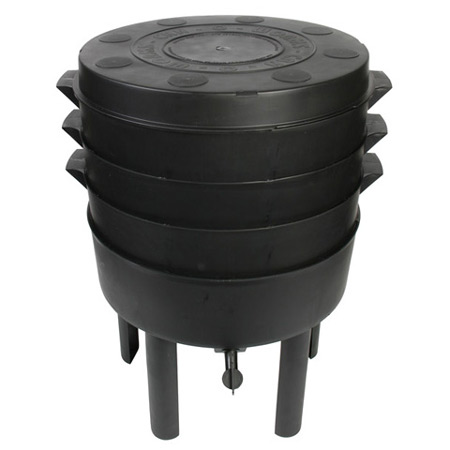
Worm Factory 360 Available Internationally!


  • Suitable for HDB, Apartments and Landed Property
  • Multi-tier system for efficient waste recycling
  • Simple to use design
  • Odorless and clean, suitable for all homes
  • Designed for easy harvesting of worm castings and worm tea (leachate)
  • Able to house up to 20,000 composting worms
  • Keeps pests and insects away

Introducing the Worm Factory 360. We are pleased to announced that we are now partners with Amazon and hence able to bring the Worm Factory 360 to your home now! Good news to Singapore customers as now Amazon ships it here! 

For more info, you can view the product here, in our International Product page. 

As for the composting worms, you can purchase it from us. 

For more enquiries, call us +65 9386 4388

Friday, 3 May 2013

What to feed your worms?

Often many queries that we received from our customers would be, " What should we feed our worms?" Or " What waste will the blue worms eat the fastest?". We have already written an article over here but this time round this post will be a little more light hearted.

One of our worms' favourite diet would be red apples. As mentioned previously, " An apple a day, keeps a worm happy :)"

This is certainly not true if all our apples are eaten this way. 


For us, we always like to have the thought that no food shall go to waste and thus we feed mainly apple cores to our worm bin. We do believe that most average people, actually eat apples with their cores intake. After all, what is wrong by eating that way? We do get more worm castings and not to mention worm tea.

For more enquiries, call us +65 9386 4388

Saturday, 16 March 2013

Worm Leachate is an Excellent Garden Fertilizer


Worm leachate is a liquid produced naturally in the worm composting process. Worm compost has an extremely high level of microscopic activity within it and it contains a large amount of microscopic bacteria breaking down your waste within the compost bin. The level of microbes and microbial activity within the worm bin is extremely high, far exceeding the levels found in normal soil, by 10 to 20 times. When liquid is passed through the worm bin, it mixes with the microbes and the resultant by product liquid is called leachate. Leachate is more commonly known as Worm Tea or Compost Tea, all referring to the same by-product of a liquid collected at the bottom of the worm bin.
Leachate is commonly collected 1-2 months after setting up your compost bin. While you may experience some liquid collection in the first few weeks, it is advisable to pour it back into the compost bin. After all, reintroducing additional microbes into the bin does no harm and all good! However, after the worm bin has ‘stabilized’ and the worms are doing their job with much efficiency, you can start collecting the Worm Tea which can be put to many uses.
Worm Tea as mentioned, contains a very high concentration of microbial activity. This is usually in excess of what plants require. To get the most out of this precious worm leachate, consider diluting it with tap water. The Compost Tea can be used as a fertilizer by applying it directly to the soil, or it can be used as a pesticide by spraying it on the plants leaves.  This will prevent insects and other unwanted garden pests from infecting your plants with diseases and eating its leaves.
Usually, self-made home compost bins are unable to collect such worm leachate as there isn’t a specialized way to harvest this useful garden liquid fertilizer. However, you can still attempt to do so by drilling holes at the bottom of your home-made worm bin. Put a tray beneath it and the dark brown liquid that you will find there is Worm Tea! For a more fuss-free way of collecting worm leachate though, use a specialized worm composting bin like the Can-O-Worms of the VermiHut. Each of these systems has a liquid storage compartment and a tap attached to it. To collect the Compost Tea, simply turn the tap and you can start using it on your plants instantly

Adopted from our website, www.worm-compost-bins.com
For enquiries contact us + 65 9386 4388

Monday, 14 January 2013

Worms are Hermaphrodites

Not many people know what is the meaning of hermaphrodites. Hermaphrodites means that one possesses both male and female organs. All worms are hermaphrodites. This is means you will only require two worms to breed and make many more babies.

Each mating partner produces a capsule (sometimes called a pod/cocoon)  or egg. Two of the species mentioned in this blog are the red worms (tigers) and blue worms. Tigers always require two worms to reproduce. The blue worms wherever, can reproduce on their own. Some claim that they have never seen two blue worms coupling and it seems like the blues are permanently parthenogenetic.

This means that when a blue worms had reached sexual maturity, it will start to reproduce on its own. How amazing is that!! Unlike other worms, no time is wasted in pre-mating courtship or finding a mate of the same species etc. This is one of the main reasons the blue worms are such great breeders!! give them a try and the next thing you need to worry is to build another worm farm. As mentioned in the precious post, they are ferocious eaters and can be great composters. 

Call us now for enquiries +65 9386 4388

Tuesday, 1 January 2013

Baby Composting Worm

Took a video on a baby composting worm. Trust me they can actually be way smaller. Hope it is clear. It's a Malaysian blue worm or Perionyx Excavatus. Stay tuned for more articles on how to breed your worms right. Meanwhile, enjoy the short video.


For more enquiries, call us at +65 9386 4388 

Thursday, 27 December 2012

Malaysian Blue Worms - Perionyx Excavatus

The blue worms or perionyx excavatus orginal home stretches from the Himalaya Mountains into the lowlands of Malaysia. Till today, some are still debating whether there are some in Singapore. Nevertheless, these worms are more commonly know as the Malaysian Blue Worms. They operate efficiently in a fairly wide range of warm temperatures and moisture levels.

Having know that they orignate from Malaysia, they are more suited for the tropical climate. They prefer very moist conditions and often seek for dark areas. In Malaysia, they have been found in jungle treetops during tropical downpours. They are mostly happy to stay in the worm beds, where there is ample of food, and trust me they breed like crazy. I personally have found them to be a very versatile worm and the most valuable type to me. If you are looking to have the fastest breeding rate, try the blue worms for yourself.  Do note that when well fed and given loads of love, they will reciprocate by breeding a tonne for you :)

The blue worms display four distinct type of colours at different stages of sexual maturity. They also display a fifth type of colour when approaching full body size. Once the perionyx excavatus reach a length of about 7.5cm. they begin to phosphoresce a deep blue/purple on exposure to light. This is why they are called the blue worms and not because they are blue in colour. As their size continue to increase, so does their degree of phosphoresce so that at their full size (15 cm contracted and 20 cm stretched out) they flash a regal purple. They are really beautiful.

Besides great composters, they are also often used as fishing bait. This is because when hooked, the blue worms will be flipping about on the hook and thus attract attention. Give it a try today!

Call us at +65 9386 4388

Monday, 3 December 2012

Vermicomposting - Worms consuming apple

A short clip on our red worms eating an apple. Reducing waste via vermicomposting is the way to go!! try it out today!


Call us at + 65 9386 4388 if you are interested in vermicomposting!

Thursday, 1 December 2011

Worm Diet

How do we keep our worms happy and healthy? The saying goes, "An Apple a day keeps the doctor away" but in this case, " An apple a day, keeps a worm happy :)"

One of the most common misconceptions are that compost worms are able to compost any organic material. This is however not true because worms, just like us humans, are also living beings and their diet must be carefully taken care.

I normally feed my worms vegetables and fruit peels. This is by far the best way to keep them alive and happy! Vegetable left overs are an excellent diet for the blue worms as they do not attract fruit flies. Almost all vegetables are suitable for the worms. Tubers such as onions and garlic,however, are not suitable to be fed to the worms

Fruits on the other hand, is otherwise. Acidic fruits such as orange peels, pineapples, lemon and etc are a big no no for the worms. This is because worms dislike them and will not compost the above. Apples is a good choice and trust me, the worms love the apple cores the best. Watermelons on the other hand, provide a good amount of water content in the worm bin.

Other daily wastes such as coffee grinds and tea bags are also suitable to be fed to the worms. Coffee grinds however must be left isolated for a week or more for the alkaline content to be reduced. Cooked and oily food should be avoided at all means. This is because the worms do not compost the cooked food and it will most likely kill them. Besides that, feeding cooked food to the worms encourages maggots and other pest. This will also make the food rot and eventually emitted a very foul smell. You probably don't want your backyard to stink!

Remember, a happy worm is a happy you ;)

Call us today +65 9386 4388

Monday, 24 October 2011

Worm Composting

Composting is the process of breaking down organic matter through aerobic decomposition. This form of decomposition makes use of bacteria, heat and oxygen to decompose plants, leaves, wood, paper, animal dung and other forms of organic matter. Worm composting therefore is composting with the aid of composting worms. This is also known as vermicomposting or vermiculture. The advantage of vermicomposting over that without the use of composting worms is that the worms speed up the composting process. However, composting can at times be as fast, if not faster than vermiculture under optimum conditions. This is usually only achieved in industries that specializes in making organic compost for sale.

For the home garden purposes, worm composting will almost certainly be faster in producing compost. There are three main types of worms that are suitable for worm composting. In layman terms, they can either be classified as ‘red worms’ or ‘blue worms’. The red worms consist of two species, the Red wigglers (Eisenia foetida or Eisenia andrei) and the European Nightcrawlers (Eisenia hortensis). The blue worms (Perionyx excavatus) are known either as Indian blue worms or Malaysian blue worms. Blue worms are more suitable for tropical countries as they live and thrive in temperatures between 20 – 35 degrees Celsius (70 – 90 degrees Fahrenheit).

All these composting worms belong to the earthworm family, and as such are hermaphrodites. Each worm has both the male and female reproductive organs. Hermaphrodites do not have males or females, but simply mate with one another to reproduce. Each cocoon produced contains about 5-6 eggs on average, depending on the environment and diet of the worms.

Worm composting is a very simple and eco friendly project that everyone can adopt. The main tools required are simply a worm bin to house the worms, the worm themselves of course, food to feed the worms, and knowledge on how to ensure that are constantly producing compost, also known as worm castings, for you. You will also be interested in knowing how to breed your worms so that your worm population can multiply and your worm farm can work at its optimum capacity.

One common question asked is do worms breed to fast, resulting in an overpopulation scenario? The answer is that worms know how to regulate their population in terms of the space and food available to them. If conditions are not suitable for a larger worm population, they will not reproduce.  Therefore, you do not have to worry about an overflowing worm bin! What you are likely to have instead is a very active worm farm continuously converting your waste products to useful castings that can be used as a fertilizer for your garden and potted plants.

Call us now +65 9386 4388
Free Delivery Islandwide

Saturday, 15 October 2011

Worm Composting

Composting is the process of breaking down organic matter through aerobic decomposition. This form of decomposition makes use of bacteria, heat and oxygen to decompose plants, leaves, wood, paper, animal dung and other forms of organic matter. Worm composting therefore is composting with the aid of composting worms. This is also known as vermicomposting or vermiculture. The advantage of vermicomposting over that without the use of composting worms is that the worms speed up the composting process. However, composting can at times be as fast, if not faster than vermiculture under optimum conditions. This is usually only achieved in industries that specializes in making organic compost for sale.

For the home garden purposes, worm composting will almost certainly be faster in producing compost. There are three main types of worms that are suitable for worm composting. In layman terms, they can either be classified as ‘red worms’ or ‘blue worms’. The red worms consist of two species, the Red wigglers (Eisenia foetida or Eisenia andrei) and the European Nightcrawlers (Eisenia hortensis). The blue worms (Perionyx excavatus) are known either as Indian blue worms or Malaysian blue worms. Blue worms are more suitable for tropical countries as they live and thrive in temperatures between 20 – 35 degrees Celsius (70 – 90 degrees Fahrenheit).

All these composting worms belong to the earthworm family, and as such are hermaphrodites. Each worm has both the male and female reproductive organs. Hermaphrodites do not have males or females, but simply mate with one another to reproduce. Each cocoon produced contains about 5-6 eggs on average, depending on the environment and diet of the worms.

Worm composting is a very simple and eco friendly project that everyone can adopt. The main tools required are simply a worm bin to house the worms, the worm themselves of course, food to feed the worms, and knowledge on how to ensure that are constantly producing compost, also known as worm castings, for you. You will also be interested in knowing how to breed your worms so that your worm population can multiply and your worm farm can work at its optimum capacity.

One common question asked is do worms breed to fast, resulting in an overpopulation scenario? The answer is that worms know how to regulate their population in terms of the space and food available to them. If conditions are not suitable for a larger worm population, they will not reproduce.  Therefore, you do not have to worry about an overflowing worm bin! What you are likely to have instead is a very active worm farm continuously converting your waste products to useful castings that can be used as a fertilizer for your garden and potted plants.

Tuesday, 11 October 2011

Can O Worms

Worm composting system bin suitable to house blue worms and red worms
  • Suitable for HDB, Apartments and Landed Property
  • Multi-tier system for efficient waste recycling
  • Simple to use design
  • Odorless and clean, suitable for all homes
  • Designed for easy harvesting of worm castings and worm tea (leachate)
  • Able to house up to 20,000 composting worms
  • Keeps pests and insects away
  • Awarded Australian Design Award

CALL US TODAY: +65 9386 4388


Thursday, 6 October 2011

Blue Worms For Sale – Free Delivery Islandwide

BLUE WORMS FOR SALE
FREE DELIVERY ISLANDWIDE


CALL US TODAY: +65 9386 4388


  • Compose any waste into fertilzers/worm castings!
  • Newspapers, Vegetable/fruit peels, leaves,tea bags etc
  • Suitable for Singapore climates and HDB homes

Price: 500g for S$125

CALL 9386 4388